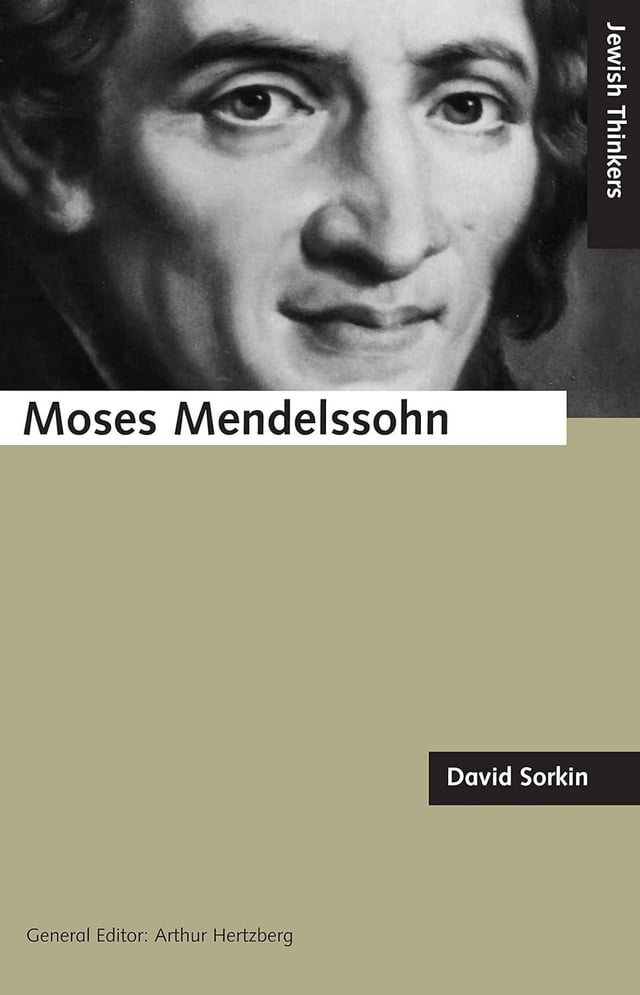
 | It can be said that we’ve ulterior motives for doing just about everything and this includes opening a book. It could be as simple as wanting to disconnect a bit from reality. It can also be an insatiable thirst to acquire more knowledge rather than washing dishes (guilty as charged). But of course it can be for more reasons as well. Case in point: before beginning Moses Mendelssohn and the Religious Enlightenment, while I knew some things about Moses Mendelssohn, some of that came from polemics against him from “traditional” Jewish sources (quotes are important given the man of the hour’s own writing that I will expand on some in this review). Is this the—and the following is a paraphrase so please don’t stone me—‘dastardly man who led to the creation of the Reform movement?’ Is Mendelssohn the one who opened the gateway for millions to confidently stroll off the derech? Out of the ghetto and into society? Or rather, can he be seen as more of an early version of Rabbi Samson Raphael Hirsch, advocating to upkeep all traditional laws while also placing one foot in secular studies? (Obviously Hirsch did not see the resemblance as he seemed to base his judgment of him solely on one of his books (paraphrased from p. 290)). Diving right in, a question I was pondering when opening this book was what was I getting into? Is this a biography of the man or a focus on one specific aspect? What we get is something closer to the latter with only scant biographical elements that don’t directly relate to his writing. Right in the Preface, David Sorkin makes it clear his book focuses heavily on Moses’s writings on Jewish Though that the authoritative biography by Alexander Altmann does not cover much: his writings in Hebrew. In fact, that—his Hebrew output—seems to be the glue missing from most modern takes on him. Reading only what he wrote in German perhaps makes him seem like a Reformer with a capital R when in reality, the opposite seemed to be his mission objective. There are some who can chart the birth of Reform Judaism to Mendelssohn and after reading this, if we had the man himself placed in a time machine and brought to the present to hear such an accusation, he’d probably punch—no, this was someone who believed whole-heartedly in faith, trust, and doing the right thing. He would disagree and then pen a treatise on it…perhaps in Hebrew. If anything, what I gained from taking a brief dive into his Hebrew works is a man who almost a century before Hirsch already saw that the best way to keep Judaism alive in an age of increased secularism was marrying some of its elements with society at large. Never did he turn away from halakha and even though some in the far right religious spectrum both then and now shunned his works, they—especially “Book of the Paths of Peace”, his pentateuch commentary. were the go-to works for most anyone including those most pious (albeit perhaps not Hasidic): >“Accompanying the first edition were a number of approbations from local rabbis who supported Mendelssohn’s pedagogical intention. They pointed to the poor state of the study of the Hebrew language and the Bible among Jews; the deficiencies of the Yiddish translations and the dangers of the Christian ones (the rabbinic court of Berlin saw Mendelssohn’s translation as an attempt “to rescue the youth of Israel from danger”); and Mendelssohn’s reliance on rabbinic tradition to ascertain the literal meaning of the text.” (p.159) One would think a book focusing intently on his writings and not even the man himself would be a tough read. And perhaps it may be if you went in knowing near nothing about him, the Haskalah, and the Enlightenment at large. I was lucky to have read other books covering this era and maybe due to that found David Sorkin’s work not a difficult read in the slightest and now feel sufficiently prepared to tackle the significantly more robust biography. 4.5/5 –Notable Highlights from Mendelssohn’s own writings— When asked about placing German textbooks in Jewish schools: The separation we need now more than ever: submitted by /u/kobushi |
Source: Reditt


![[link]](https://i.redd.it/4wx71f9sueaf1.jpeg)